Laptop Battery Airplane Rules: Watt-Hour Limits, Carry-On and Power Banks
Laptop battery airplane rules explained: carry-on vs checked bags, the 100 Wh and 160 Wh limits, how to calculate Wh, and spare power bank rules.
Can I take a laptop on a plane?
Laptop battery airplane rules let you fly with a laptop as long as its battery stays within the watt-hour (Wh) limits in IATA's passenger guidance; batteries up to 100 Wh need no airline approval. The rules depend on the battery's Wh rating and on whether the battery is installed in the device or carried as a spare. Installed batteries have more flexibility; spare batteries and power banks are restricted to carry-on bags.
International rules are built on the IATA Dangerous Goods Regulations, and national agencies such as Canada's CATSA and the UK Civil Aviation Authority publish their own passenger guidance. Airlines can apply stricter limits than these baselines, so your carrier's policy is the final word for any specific flight.
Carry-on or checked bag?
IATA's passenger table lists portable electronic devices such as laptops with batteries up to 160 Wh as allowed in both carry-on and checked baggage, with airline approval needed above 100 Wh. However, IATA's traveler guidance advises that lithium-powered devices should be carried in hand baggage, and it asks passengers to remove lithium devices and batteries if a cabin bag is taken at the gate for the hold.
CATSA gives the same practical advice: keep batteries and devices containing batteries on you or in your carry-on, and check with your airline because not all carriers accept lithium batteries in checked bags. Keeping the laptop with you is the simplest way to stay within every layer of these rules.
The 100 Wh and 160 Wh limits
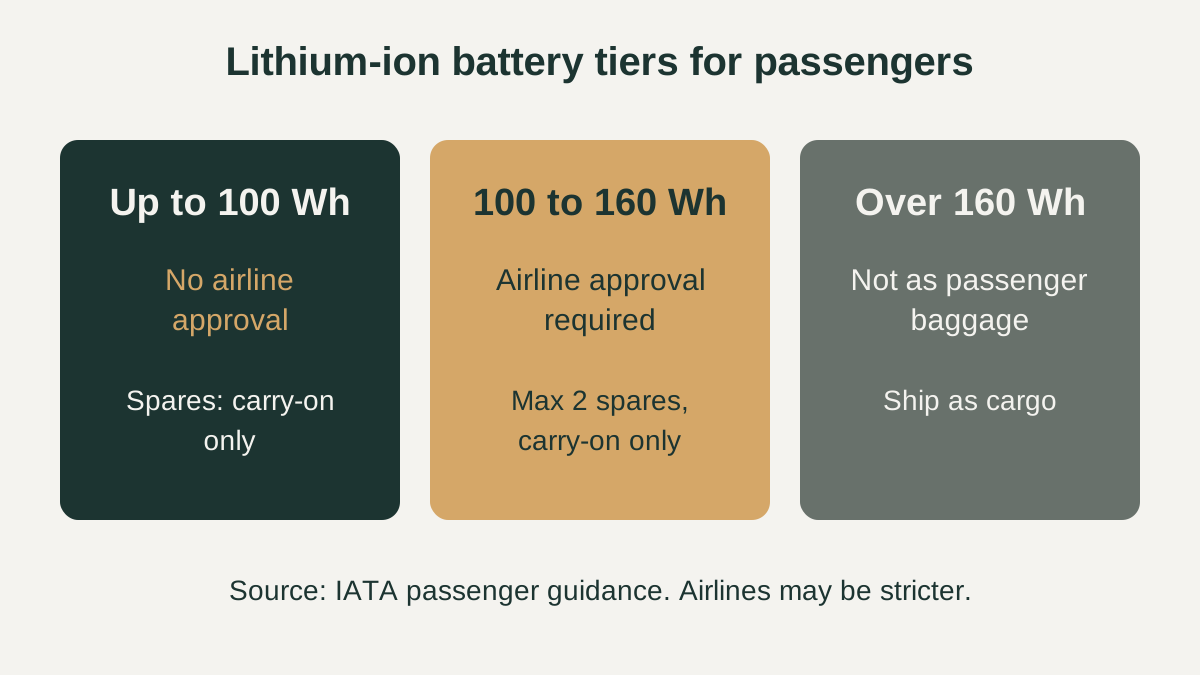
The limits work in tiers. Lithium-ion batteries rated at 100 Wh or less need no airline approval, whether installed or spare. Batteries above 100 Wh and up to 160 Wh need approval from the airline, and IATA limits spares in that band to two per person. Batteries above 160 Wh cannot travel as passenger baggage and must be shipped as cargo under the IATA Dangerous Goods Regulations.
IATA also sets quantity caps: each person may carry up to 15 portable electronic devices and up to 20 spare batteries of any type, though the airline may approve more. These caps rarely affect a laptop traveler, but they matter for photographers or teams moving several devices together.
| Battery rating | Installed in laptop | Spare battery or power bank | Airline approval |
|---|---|---|---|
| Up to 100 Wh | Carry-on or checked | Carry-on only (max 20 spares) | Not required |
| Over 100 Wh to 160 Wh | Carry-on or checked | Carry-on only (max 2 spares) | Required |
| Over 160 Wh | Not as passenger baggage | Not as passenger baggage | Must ship as cargo |
How to find the Wh rating on a battery
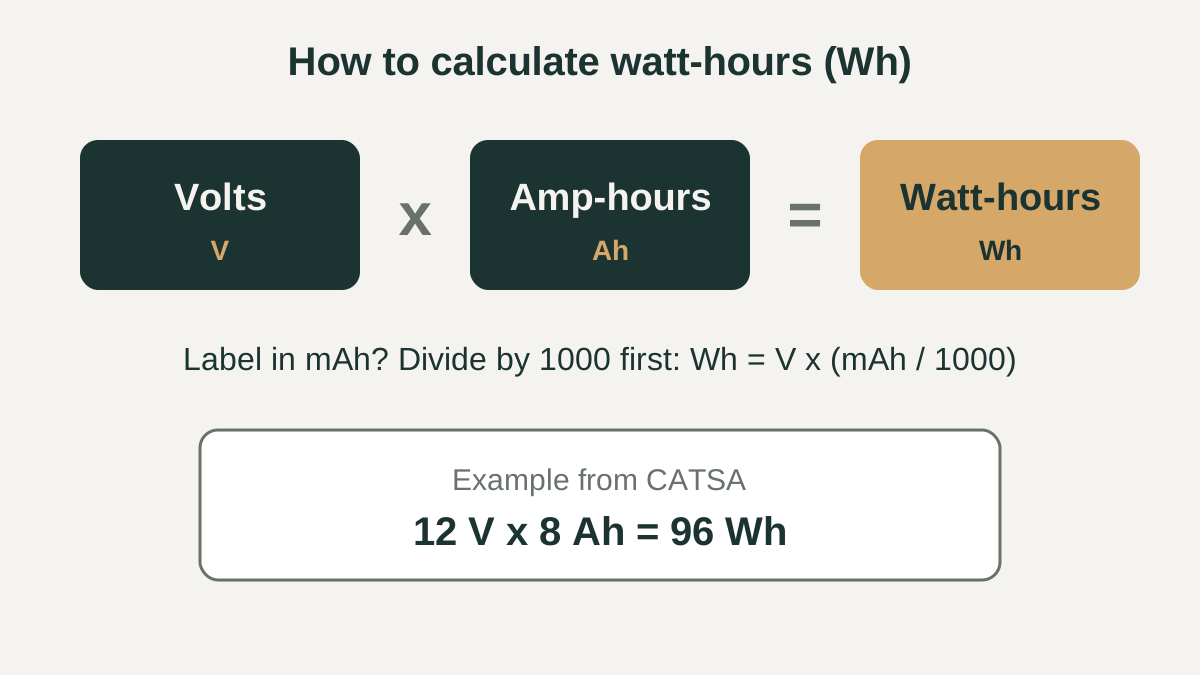
Look for the watt-hour figure printed on the device or battery label, as IATA advises. Many laptop batteries show it directly. If only voltage and capacity are printed, CATSA gives the formula: watt-hours equal volts multiplied by amp-hours (Wh = V x Ah). For a capacity in milliamp-hours, divide by 1,000 first, so Wh = V x (mAh / 1000).
CATSA's worked example is a 12-volt battery rated at 8 Ah, which comes to 96 Wh and sits under the 100 Wh line. Use the battery's nominal voltage from the label, not the charger output voltage. If the label is missing or unreadable, the manufacturer's specification sheet or support page is the next place to check.
Spare batteries and power banks
IATA treats power banks as spare batteries, so they must travel in carry-on baggage only. Each spare must be protected against short circuits: keep it in its original retail packaging, tape over exposed terminals, or place it in a separate plastic bag or protective pouch. CATSA adds that power banks should not go in overhead bins and that many airlines prohibit charging devices on board.
Rules have tightened. In its guidance for airlines, the UK CAA states that from 27 March 2026, passengers may carry a maximum of two power banks each, power banks must not be recharged on board, and they should not be used to charge other devices on board. Power banks from 100 Wh to 160 Wh still need operator approval, so confirm the airline's current position before packing one.
Checklist before you fly
A few minutes of preparation avoids surprises at security or the gate. Airline approval for larger batteries is handled by each carrier, so contact the airline in advance if any battery is above 100 Wh, and keep a note of its Wh rating handy in case staff ask to see it. Rules can change between booking and departure, so recheck the airline page close to your travel date.
- Read the Wh rating on the laptop battery label, or calculate it with Wh = V x Ah.
- Pack the laptop in your carry-on and remove it if your cabin bag is gate-checked.
- Keep every spare battery and power bank in carry-on, with terminals protected.
- Request airline approval in advance for any battery over 100 Wh up to 160 Wh.
- Limit spares in the 100 to 160 Wh band to two, and check your airline's power bank count.
- Charge devices before boarding, since many airlines restrict charging power banks on board.